

A practical, parent-friendly guide to the real physical, mental, and social benefits of outdoor play and simple ways to build it into your child’s everyday routine.
Ask any parent in Delhi, Mumbai, or Bengaluru what their child did after school twenty years ago, and the answer was almost always the same when they were outside. Today, that answer is more likely to involve a screen. Here’s why bringing outdoor play back matters more than most of us realise.
Outdoor play isn’t just “letting kids burn off energy.” It’s one of the most powerful, free, and natural tools we have for raising physically strong, emotionally balanced, and socially confident children. And the good news is that bringing it back doesn’t require a fancy gadget or an expensive academy: just a ball, a paddle, some open space, and a little encouragement. In this article, we’ll break down exactly why outdoor play matters so much for a child’s growth, what the research actually says, and simple ways you can build more of it into your child’s everyday routine.
What Is Outdoor Play, Really?
Outdoor play is any unstructured or semi-structured physical activity that happens outside: running, jumping, throwing, climbing, cycling, or playing a sport like badminton or pickleball in a park, society ground, or backyard. It’s different from organised sport in one key way: it doesn’t always need a coach, a fixed time, or a scoreboard. Sometimes it’s just three kids and a ball figuring out their own rules. That spontaneity is exactly what makes it so valuable.
Why Is Outdoor Play Important for Physical Growth?
Children’s bodies are built to move, and outdoor play gives them the kind of movement that indoor activities simply can’t replicate.
Stronger bones and muscles: Running, jumping, and climbing place healthy stress on growing bones, helping build density and strength during the years it matters most.
Better coordination and balance: Catching a ball, dodging a friend, or returning a shuttlecock trains the brain and body to work together, the foundation of every other physical skill a child will learn later.
Healthier weight management: With rising childhood obesity in urban areas a growing concern, regular outdoor activity is one of the simplest counterbalances available.
Improved immunity: Fresh air, sunlight, and natural movement all support a stronger, more resilient immune system in growing children.
Better sleep: Physically active children tend to fall asleep faster and sleep more deeply, supporting everything from mood to memory.
A simple way to think about it: a child who plays outside for an hour a day isn’t just having fun: they’re quietly building the physical foundation they’ll rely on for the rest of their life.
How Does Outdoor Play Support Mental and Emotional Growth?
This is the part that often gets overlooked. Outdoor play isn’t only about the body, it does just as much for the mind.
It reduces stress and anxiety: Physical activity releases endorphins, the body’s natural mood lifters. A child who’s had a rough day at school often comes back from twenty minutes of outdoor play noticeably calmer.
It builds focus and attention: Time spent in green, open spaces has been linked to improved concentration afterward: almost like the brain gets a reset.
It boosts confidence: Mastering a new skill, whether it’s riding a bicycle without support or finally winning a rally in badminton, gives children a real, earned sense of “I can do this” that carries into the classroom and beyond.
It teaches emotional regulation: Losing a game, missing a catch, or being picked last for a team are small disappointments that teach children how to handle setbacks, a skill no worksheet can substitute for.
What Are the Social Benefits of Outdoor Play?
Most outdoor play happens with other children, and that’s where some of its quietest benefits show up. Sharing equipment teaches patience and fairness Team games teach cooperation and communication Resolving an “out or not out” dispute teaches negotiation Including a younger or shy child teaches empathy These aren’t lessons you can teach through a lecture. Children absorb them by doing, and outdoor play is one of the richest, lowest-pressure environments for that kind of learning.
Is Screen Time Really Replacing Outdoor Play in India?
- Most outdoor play happens with other children, and that’s where some of its quietest benefits show up.
- Sharing equipment teaches patience and fairness
- Team games teach cooperation and communication
- ‘Resolving an “out or not out” dispute teaches negotiation
- Including a younger or shy child teaches empathy
These aren’t lessons you can teach through a lecture. Children absorb them by doing, and outdoor play is one of the richest, lowest-pressure environments for that kind of learning.
Is Screen Time Really Replacing Outdoor Play in India?
It’s a fair question, and the honest answer is: largely, yes. Paediatricians and child development experts have flagged that recreational screen time among children has risen sharply over the past few years, often crossing recommended limits well before the teenage years. This isn’t about demonising technology, screens have their place. But when outdoor play gets squeezed out entirely, children lose access to movement, sunlight, social interaction, and unstructured problem-solving all at once. The goal isn’t zero screen time; it’s making sure outdoor play gets its fair share of the day too.
How Much Outdoor Play Does a Child Actually Need?
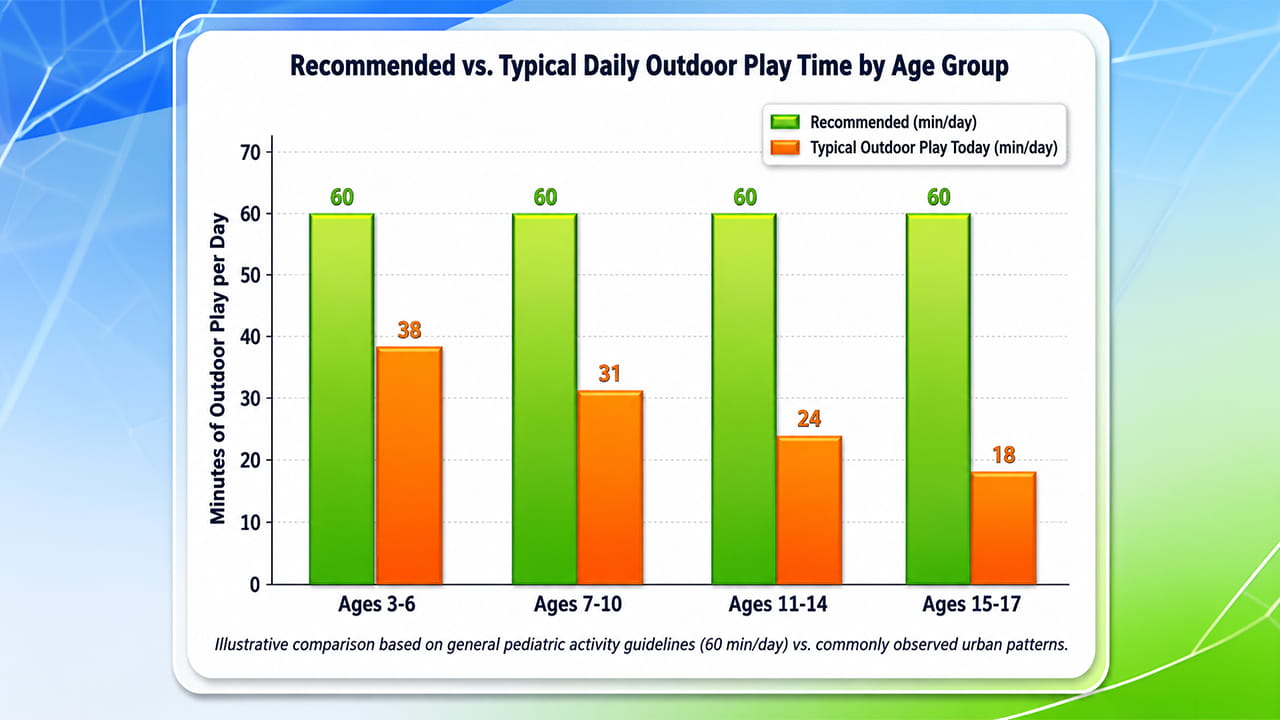
Most paediatric guidelines suggest children get at least 60 minutes of moderate-to-vigorous physical activity every day, ideally more on weekends or holidays. That doesn’t need to happen in one block – a quick game before school, an evening session after homework, and a longer weekend play session can together build a strong weekly habit. The chart below shows roughly how a child’s outdoor play time tends to compare against recommended levels in many urban Indian households today.
The gap is real, but it’s also closeable – often with nothing more than a consistent slot in the daily routine and the right, simple equipment to make play genuinely fun.
Which Outdoor Activities Are Best for Different Age Groups?
Ages 3–6: Simple ball play, tricycles, sandpit games, and basic catch-and-throw activities that build coordination without needing rules.
Ages 7–10: Badminton, group ball games, skipping, and introductory racket sports like pickleball, which are easy to learn and naturally social.
Ages 11 and above: Structured sports such as badminton, pickleball, cricket, and football, which combine fitness with teamwork, strategy, and healthy competition. Racket and paddle sports deserve a special mention here. Games like badminton and pickleball are ideal because they’re low-cost to start, playable in small spaces like a terrace or society ground, and naturally scale in difficulty as a child improves, keeping them engaged for years rather than weeks.
How Can Parents Encourage More Outdoor Play?
You don’t need a big plan, small, consistent changes work best.
- Set a daily play window: Even 30–45 minutes at a fixed time builds a habit faster than an occasional “let’s go play.”
- Keep equipment visible and ready: A ball or badminton set sitting by the door gets used far more than one packed away in a cupboard.
- Play with your child sometimes: Children are far more likely to go outside if a parent occasionally joins in.
- Involve their friends: Outdoor play is more fun in groups, and group habits stick longer than solo ones.
- Choose durable, easy-to-use gear: Equipment that survives daily outdoor wear removes the friction of “it broke last week” and keeps the habit alive.
What Role Does the Right Equipment Play?
This is where a lot of well-intentioned outdoor play plans quietly fall apart. A flimsy ball that deflates in a week or a shuttlecock that frays after a few rallies teaches a child that outdoor play is disappointing, not fun.
The Final Word
Make Outdoor Play a Daily Habit, Not an Occasional Treat Outdoor play isn’t a luxury or a “nice to have”. it’s one of the most direct ways to support a child’s physical strength, mental wellbeing, and social skills, all at the same time.
Ready to Get Your Child Off the Screen and Onto the Field?
The good news is that it doesn’t take much to start: a fixed time slot, some open space, and equipment that’s actually built to be played with every single day.
Explore our ranges of sports goods, balls, and outdoor toys built specifically for the everyday play Indian kids deserve.
Frequently Asked Questions
- Why is outdoor play important for children?
Outdoor play supports physical strength, coordination, and immunity while also building focus, confidence, and emotional resilience – benefits that indoor or screen-based activities can’t fully replace.
- How much outdoor playtime does a child need each day?
Most paediatric guidelines recommend at least 60 minutes of moderate-to-vigorous outdoor activity daily, which can be split across smaller sessions rather than one long block. - Does outdoor play really help with a child’s mental health?
Yes. Physical activity outdoors helps lower stress and anxiety, improves focus, and gives children a natural, healthy way to process emotions and build self-confidence. - What are good outdoor sports for beginners?
Badminton and pickleball are excellent starting sports: they’re easy to learn, need minimal space, and are gentle enough for young beginners while still being fun for the whole family. - Is pickleball suitable for kids?
Yes, pickleball is one of the most beginner-friendly racket sports available. Its smaller court, lighter paddles, and simple rules make it easy for children to pick up quickly and enjoy. - How can I get my child interested in outdoor play if they prefer screens?
Start small with a fixed daily play window, join in yourself occasionally, involve friends, and use durable, fun equipment like a good ball or paddle set: engagement usually follows naturally once the habit starts. - What’s the difference between outdoor play and organised sport?
Outdoor play is often unstructured and spontaneous, like a casual game in the park, while organised sport involves set rules, coaching, and competition. Both are valuable, and most children benefit from a mix of both.