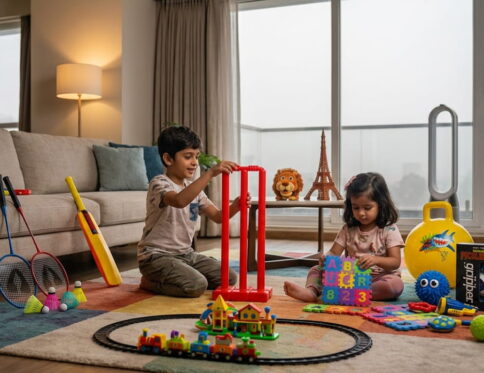


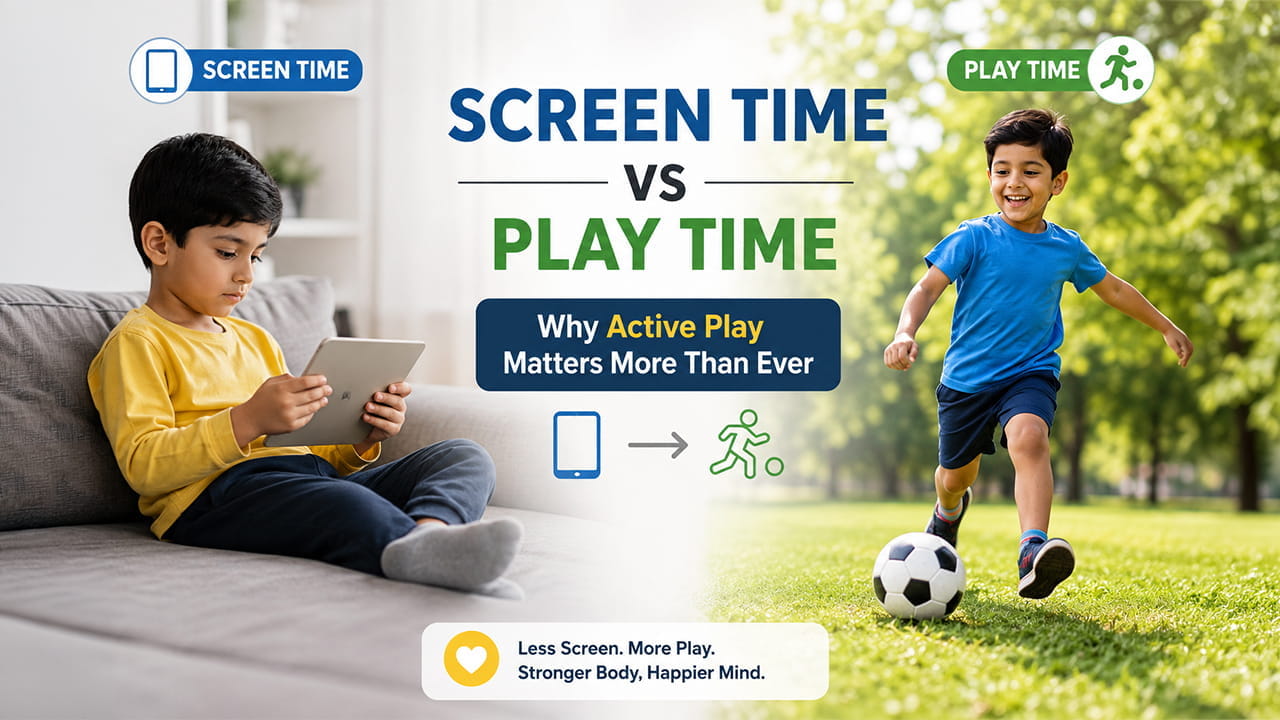
Indian children now spend nearly three times more hours on screens than in active play. Here’s what the research says and how parents can fix the balance, starting today.
Walk into almost any Indian home in the evening and you’ll see it: a child curled up on the sofa, eyes locked on a tablet, while a perfectly good cricket bat or skipping rope sits untouched in the corner. If that sounds familiar, you’re not imagining it and you’re definitely not alone. The conversation around screen time vs play time isn’t just a parenting trend. It’s backed by hard numbers from hospitals, universities, and global health bodies and the numbers are honestly a little startling. Indian children today are spending far more hours on screens than they spend on the kind of active, physical play that paediatricians say their growing bodies and brains actually need. So what’s really happening when screens edge out playtime?
And more importantly, what can parents do about it without turning every evening into a battle? Let’s look at what the research actually shows.
What Is the Real Difference Between Screen Time and Play Time?
Screen time means any time a child spends watching or interacting with a phone, tablet, TV, or computer, cartoons, games, video calls, all of it. Active play means physical movement: running, climbing, building, throwing, jumping, or simply chasing a friend around the garden. The real difference isn’t “indoors vs outdoors” it’s what the body and brain are doing. Screen time is mostly sedentary; the body stays still while the eyes and mind do the work. Active play engages muscles, balance, coordination, and social skills all at once, which is exactly why doctors keep pointing back to it
How Much Screen Time Are Indian Kids Actually Getting?
More than most parents expect: and far above what paediatric guidelines recommend. A 2025 systematic review of screen use among under-five children in India found that the average child under five spends about 2.22 hours a day in front of a screen: more than double the Indian Academy of Pediatrics’ (IAP) recommended limit of under one hour a day for this age group. It gets steeper as children grow older. A 2025 study from Greater Noida, surveying parents of school going children with an average age of 10.9 years, found average screen time had climbed to 3.06 hours a day, while average outdoor play added up to just 11.23 hours a week: a little over 1.5 hours a day Other regional surveys paint a similar picture: In a rural Haryana study by AIIMS, just over half of children aged 2–4 years were already crossing the WHO’s one-hour screen limit, and one in four had started screen use before turning two. In Rajkot, a university survey found 81% of children under 10 used screens regularly during meals — turning a family ritual into another screen session.

What Do WHO and IAP Actually Recommend by Age?
Both the World Health Organization (WHO) and the Indian Academy of Pediatrics (IAP) agree on one thing: younger children need close to zero screen exposure, and the limits loosen only gradually.
Notice what’s missing: a strict screen cap for older children and teens? WHO doesn’t fix one for that age group, because the more useful question becomes how much of the day is active, not just how many minutes are spent on a phone.

What Happens to a Child’s Body and Brain When Screens Replace Play?
The short answer: quite a lot, and not in a good way. Eyesight. This is the most visible impact. Myopia (nearsightedness) among urban Indian children aged 5 to 15 has climbed from 4.4% in 1999 to 21.1% in 2019: nearly a fivefold jump in two decades. Eye doctors now project this could reach roughly one in three children by 2030, and as many as half of all urban children by 2050
AIIMS Delhi has found that roughly one in eight school children in the capital already wears corrective glasses, with some studies in South and Northeast India reporting rates as high as one in three. A separate study found that over half of under-five children with extended screen exposure showed signs of digital eye strain: fatigue, headaches, and disturbed sleep.

Worth knowing:
Countries like Taiwan and China have measurably lowered childhood myopia rates by mandating 40–60 minutes of outdoor time at school every day. Natural light exposure appears to help slow the kind of eye growth behind myopia, something a screen simply cannot offer.
Behaviour and attention: Indian research links screen time above two hours a day with higher anxiety scores, more behavioural problems, and weaker academic performance. A wider review found that 39–44% of Indian adolescents show signs of smartphone addiction, often rooted in screen habits formed much earlier in childhood.
Body weight and fitness: The same Greater Noida study found a clear correlation between screen hours and higher BMI in children, echoing global research connecting sedentary screen habits to childhood weight gain.
Why Does Active Play Matter More Than Ever for Growing Kids?
Because play isn’t just “letting off energy” it’s literally how young brains build themselves. Researchers studying early years classrooms found that when children were given more time and space for active play, 88% of educators observed clearly better cognitive development, and 75% saw improved emotional development in the children they worked with. A separate study following toddlers found that 85% naturally preferred active play over sedentary activities, suggesting it isn’t just good for them, it’s what their bodies are wired to seek out. Here’s what active play builds that a screen simply can’t:
Motor skills and coordination: running, climbing, and throwing develop the fine and gross motor skills children need for everything from handwriting to sport
Social and emotional skills: negotiating turns, resolving small conflicts, and reading a teammate’s cues during play
Confidence and self-esteem: mastering a new physical skill, a cartwheel, a serve, a first bicycle ride, gives kids a real sense of achievement
Long-term activity habits: children who are more active in their preschool years tend to stay more active right through primary school
There’s a sobering flip side too: physically inactive children are more likely to become overweight, and lower childhood fitness has been linked to weaker academic outcomes later on.
How Much Active Play Does My Child Actually Need Each Day?
For children aged 5 to 17, the WHO recommends at least 60 minutes of moderate-to-vigorous physical activity every single day and more is even better. This can happen in one block or spread across the day in shorter bursts of running, sport, or active games. For children aged 3 to 5, US physical activity guidelines suggest an even more generous target: at least 3 hours of active play of any intensity spread through the day, since movement at this age supports physical growth and brain development at the same time. The good news?
This doesn’t need to mean formal exercise. Play, games, sport, walking to the park, and even active household chores all count toward this daily total.
How Can Parents Actually Balance Screen Time and Play Time at Home?
Knowing the numbers is one thing: changing the evening routine is another. A few changes that genuinely work:
- Protect screen-free zones. Keep mealtimes and the first 30 minutes after school screen-free. These small windows add up fast.
- Trade, don’t just cut. Swap 30 minutes less screen for 30 minutes of active play, ideally outdoors, rather than simply removing screen time
- Make play the easy choice. Keep a ball, a paddle, or a skipping rope within easy reach so play takes less effort to start than switching on a screen.
- Let boredom do its job. Unstructured time without a screen is often where children invent their own games: exactly when creativity and problem-solving kick in.
- Play together. Children are far more likely to choose active play when a parent or sibling joins in, even for just 10–15 minutes.
- Use outdoor time for eye health too. Aim for 40–60 minutes outdoors daily, the natural light itself is one of the simplest protective habits against myopia.
Which Active Play Options Work Best at Different Ages?
Different ages need different kinds of play to stay genuinely engaged
The goal isn’t to fill every hour with structured activity, it’s to make active play the easy, default choice on most days.

Frequently Asked Questions
Q. What is the WHO recommended screen time limit for toddlers?
The WHO recommends zero screen time for children under 1 year, and no more than 1 hour a day for children aged 2 to 4 with less being better. Is some screen time okay for kids?
Yes. Experts agree that screen time itself isn’t the enemy, the concern is when it replaces sleep, active play, and face-to-face interaction. High-quality, supervised content in moderation is very different from unlimited, unsupervised use.
Q. How can I get my child to play more and use screens less?
Start by trading rather than cutting: swap a fixed block of screen time for an equal block of active play, keep play equipment visible and accessible, and join in yourself for the first few minutes.
Q. Does active play really improve a child’s brain development?
Yes. Studies of early years classrooms found that most educators observed clear improvements in children’s cognitive and emotional development when active play was prioritised, and active play is consistently linked to better motor skills, social development, and school readiness.
Q. Can outdoor play help prevent myopia in children?
Outdoor time and natural light exposure are associated with lower myopia risk. Countries like Taiwan and China have lowered childhood myopia rates by mandating 40–60 minutes of outdoor time at school each day.
Q. How much active play time does a 5-year-old need per day?
Children aged 3 to 5 should be active throughout the day, with general guidelines suggesting at least 3 hours of play of any intensity. From age 5 onward, at least 60 minutes of moderate-to-vigorous activity daily is recommended.
Q. At what age should children start using screens?
Both the WHO and IAP recommend avoiding screens entirely before age 2, aside from occasional supervised video calls with family.
Make Active Play the Easy Choice at Home
From VoltPro’s pickleball and outdoor sports range to Mega Wood’s Montessori-inspired toys, explore play that gets kids moving, not just watching.