

No club, no membership, no problem. Here’s exactly what you need gear, space, rules, and beginner tips, to start playing pickleball at home this week.
Pickleball seems to have appeared out of nowhere, paddles in every sports store window, neighborhood groups organising matches, a court popping up in the society parking lot. If you’ve been curious but haven’t picked up a paddle yet, here’s the good news: you don’t need a club membership or a fancy facility to start. You can begin playing pickleball at home, in your driveway, on your terrace, or at the local park, this week. This guide covers everything you actually need: why the sport has exploded the way it has, the gear required, the rules that matter on day one, how much space you really need, and a few simple ways to get good fast.
What Exactly Is Pickleball, and Why Is Everyone Suddenly Playing It?
Pickleball is a paddle sport that borrows from tennis, badminton, and table tennis. You hit a perforated plastic ball over a low net using a solid paddle, on a court roughly a quarter the size of a tennis court. It’s usually played in doubles, which makes it social, low-running, and easy to pick up even on your first day. The growth numbers explain the buzz. Worldwide participation has reached an estimated 48.3 million players as of 2025, growing 158% over just five years. India has been one of the standout markets, equipment participation here grew 32% year-on-year, the highest growth rate anywhere in the Asia Pacific region. Delhi alone now has roughly 300 pickleball courts, up from almost none just a few years ago, with neighbourhoods like Dwarka, Rohini, and South Delhi converting old badminton and tennis courts to keep up with demand.
What Equipment Do You Actually Need to Start?
Less than you’d think. To play your first game, you need exactly four things.
Beginner tip: Resist the urge to buy a premium paddle on day one. An entry-level paddle is more than capable while you’re learning the basics, upgrade once you know your playing style. Sets designed for learners and junior training, like VoltPro’s pickleball paddle range, are a practical place to start.

How Much Space Do You Actually Need at Home?
This is usually the first worry and it’s smaller than most people expect. A full pickleball court is just 20 feet wide by 44 feet long (880 sq ft), the exact same footprint as a badminton doubles court. If you’ve ever had space for badminton, you have space for pickleball.
For comfortable play, USA Pickleball recommends a buffer of roughly 30 by 60 feet (1,800 sq ft) to give players room to move and chase wide balls. Compare that to a full tennis doubles court at 2,808 sq ft, and pickleball starts to look like the space-efficient choice it actually is. In a typical Indian home, that translates to
A driveway or basement parking area: the most common home setup, especially if it’s concrete or paved
A terrace or rooftop: great for apartments, as long as the surface is flat and free of slippery tiles
A society common area or unused tennis/badminton court: often just needs a portable net and a free evening slot
Half a court for solo drills:perfectly fine if you’re practising alone against a wall or with one partner.

What Are the Official Court Dimensions and Net Height?
Even if your home setup is scaled down, it helps to know the official numbers so your lines and net height stay close to regulation:
The kitchen (non-volley zone) is the 7-foot strip on each side of the net where players cannot hit the ball before it bounces, this is what makes pickleball pickleball, encouraging strategy over raw power. The net sits at 36 inches on the sidelines, dipping to 34 inches at the center, slightly lower than a tennis net to keep rallies going.
How Do You Set Up a Temporary Court at Home?
- Pick a flat, hard surface. Concrete, asphalt, or sealed terrace tiles give the most consistent bounce. Grass works in a pinch but bounce will be uneven.
- 3 Mark your lines. Sidewalk chalk is cheap and washes away after play; painter’s tape or vinyl court tape lasts longer if you’re playing regularly.
- Set the net at the right height. Double-check 36 inches at the sidelines and 34 inches at the centre even an inch off changes how the ball plays
- Orient the court north: south if outdoors. This keeps direct sun out of players’ eyes during peak serving angles, especially in the evening.
- Leave a clear buffer. A few feet of run-off space beyond the baselines and sidelines prevents awkward trips and lets you chase wide shots safely
What Are the Basic Rules Every Beginner Must Know?
Pickleball’s rules sound technical on paper but click fast once you’re on the court. Here are the four that matter most on day one.
One beginner-friendly shortcut: USA Pickleball now permits a drop serve, where you simply drop the ball and hit it after it bounces. It skips the stricter arm-motion rules of a traditional volley serve and is a great way to start serving confidently from your very first session.
How Many Calories Does Pickleball Actually Burn?
More than most people expect from a “gentle” sport. A study from Western State Colorado University found that players averaged 108 beats per minute and burned around 354 calories per match: classified as moderate-intensity exercise. Separately, researchers at Brigham Young University found that doubles pickleball raises heart rate by 14% and calorie burn by 36% compared to a regular walk of the same duration. What makes it stand out is the combination: a real cardiovascular workout, low impact on joints compared to running or tennis, and constant lateral movement that builds balance and coordination which is exactly why the sport has become genuinely multigenerational, with grandparents and teenagers often sharing the same court.
What Are Simple Beginner Tips to Improve Fast?
- Start with doubles. You cover less court, which means more time to think and react while you’re still learning positioning.
- Practice “drinking.” Soft, controlled shots into the opponent’s kitchen are far more useful early on than trying to smash every ball.
- Use the drop serve. It removes the awkward arm-arc rules of a traditional serve, so you can focus on placement instead.
- Stay out of the kitchen until you need it. Most beginner faults happen from stepping on the kitchen line during a volley: watch your feet, not just the ball.
- Play little and often. Even 20–30 minutes a few times a week builds muscle memory faster than one long session on the weekend.
Which Age Groups Can Actually Play Pickleball at Home?
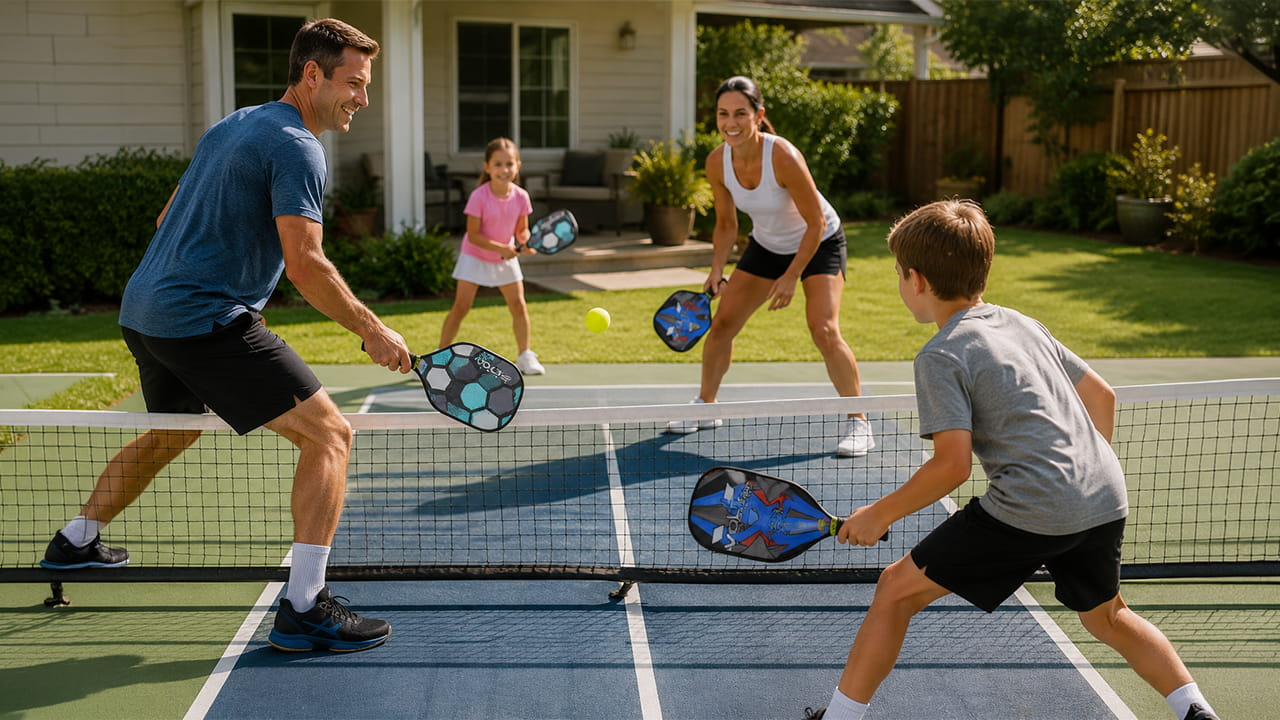
Almost all of them, which is part of why it works so well as a home activity. The court is small enough for kids to cover, the underhand serve is easy to learn young, and the low-impact nature means parents and grandparents can comfortably join the same game. A home setup that doubles as a casual evening activity for the whole family tends to get used far more often than equipment that only one person in the house knows how to use.
Frequently Asked Questions
Can I play pickleball without a permanent court?
Yes. A portable net plus chalk or tape for the lines is enough to set up a temporary court on any flat driveway, terrace, or basement parking area in under 15 minutes.
What is the minimum space needed to play pickleball at home?
A full court needs 20×44 feet (880 sq ft) – the same footprint as a badminton doubles court. With buffer space for movement, 30×60 feet (1,800 sq ft) is ideal, but a smaller, scaled-down version works fine for casual or practice play.
Do I need an expensive paddle to start?
No. A solid entry-level paddle is enough to learn the game and your own playing style. Many players only invest in a premium paddle after a few months of regular play.
What is the double bounce rule in pickleball?
The ball must bounce once on the serve and once again on the return shot before either team is allowed to hit it out of the air (volley). This keeps the serving team from rushing the net immediately.
Is pickleball good exercise for beginners?
Yes. Studies show it raises heart rate into a moderate-intensity zone and burns roughly 300–450 calories per hour for most players, while staying lower-impact on joints than running or tennis.
Can kids and adults play pickleball together?
Yes – this is one of pickleball’s biggest appeals. The smaller court and underhand serve make it genuinely playable across generations in the same match.
What surface is best for a home pickleball court?
Concrete, asphalt, or sealed terrace flooring give the most consistent ball bounce. Grass and uneven surfaces can work for casual play but make the ball bounce unpredictably
Ready to Set Up Your First Court?
VoltPro’s pickleball paddles, balls, and training sets are built to help beginners – including young players – start strong at home.