

A complete, India-focused setup guide for 2026 – dimensions, surfaces, real costs, RWA approval tips, and a 9-step checklist.
Why Everyone’s Suddenly Talking About Backyard Pickleball
A few months ago, “pickleball” would have gotten you blank stares in most Indian housing society WhatsApp groups. Today it’s the one thing actually getting residents off their balconies, paddle in hand. Whether you’re eyeing a corner of your backyard or pitching a full court to your RWA, here’s everything you need to plan it right, with real Indian numbers, not guesswork.
What Are the Official Pickleball Court Dimensions?
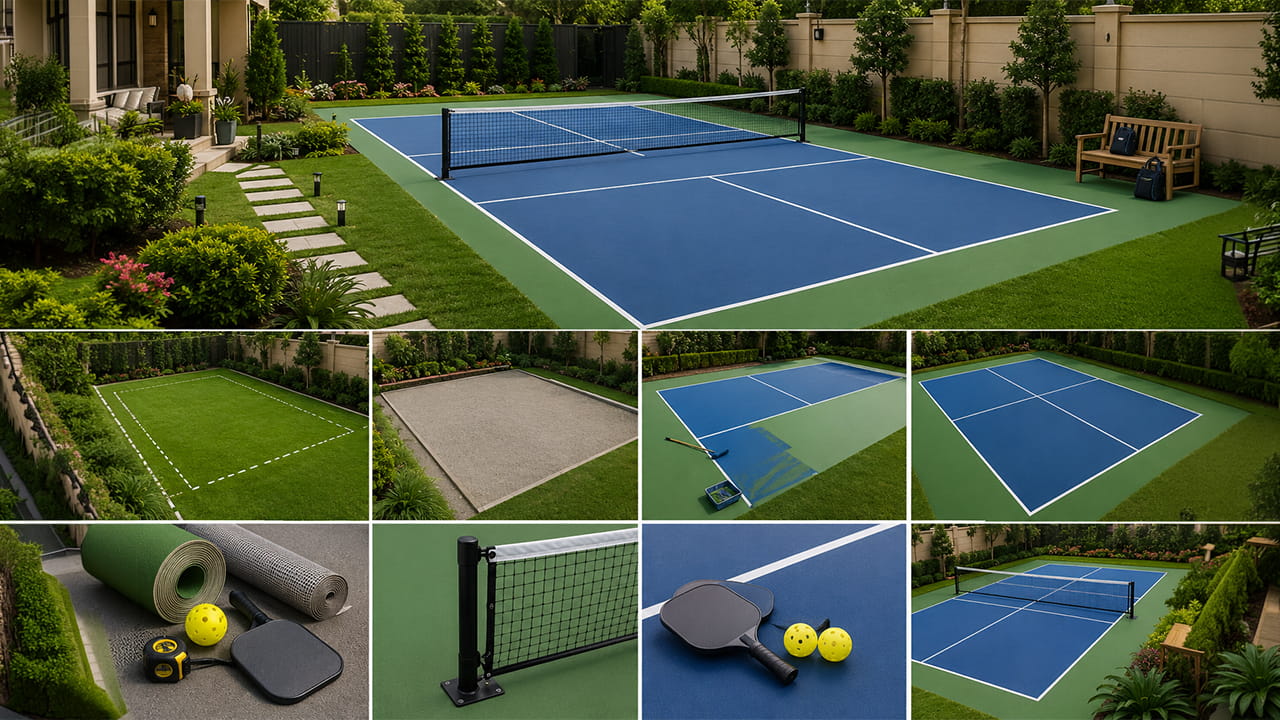
A regulation pickleball court is 20 feet wide by 44 feet long: 880 sq ft of actual playing surface, split by a net that sits 36 inches high at the sidelines and dips to 34 inches at the center. The most important zone is the kitchen (the non-volley zone) a 7-foot strip on each side of the net where players can’t hit the ball before it bounces. Beyond the kitchen, each half splits into two 10×15 ft service boxes.
Good to know: Pickleball uses the same court size for singles and doubles, no extra alleys like tennis. And because it’s identical to a doubles badminton court, many Indian societies simply repaint an existing badminton court instead of building fresh.

How Much Space Do You Really Need?
The 20×44 ft figure is just the painted playing area, build to that exact size and you’ll be lunging into a wall or a flower bed during your first rally. For a comfortable backyard or society setup, plan for a total footprint of at least 30 ft x 60 ft (1,800 sq ft), which adds safety run-off on every side. A useful shortcut: a standard tennis court (60×120 ft) comfortably fits four pickleball courts side by side. If your society already has one underused tennis court, you may already have enough room for an entire pickleball zone. Orientation tip: lay the court north-south wherever possible. East-west courts mean someone stares straight into the rising or setting sun for an entire game.
Which Surface Is Best for Indian Conditions?
Surface choice decides your budget and your court’s long-term durability. Here’s how the common options compare.
Acrylic flooring is the default across Indian societies for good reason: it copes far better with monsoon humidity, summer heat, and daily foot traffic, and a well-installed surface lasts 5–8 years with only minor recoating.

How Much Does It Cost to Build a Court in India?
Costs vary a lot depending on whether you’re testing the waters or building a permanent fixture. Here’s the full 2026 range, alongside how fast the sport itself is growing across India:
A big chunk of any permanent build goes into site preparation and the base:not just the surface coating. Drainage slope, fencing, net posts, and lighting for evening play all add to the final bill. Get a written, itemized quote before signing off, and never skip the base work to save money – that’s what determines whether your court survives its first monsoon.

Can You Convert an Existing Badminton or Tennis Court?
Badminton → pickleball: Same 20×44 ft footprint: repaint lines in a contrasting colour and use a lower, adjustable net. Tennis → pickleball: A full tennis court splits into up to four pickleball courts. Lower the net using the center strap (most tennis nets already have one), then mark new lines in a colour that won’t clash with the tennis lines. This conversion route is exactly how many housing societies in Delhi NCR, Mumbai, and Bengaluru have added pickleball without a single new construction project.
How Do You Get RWA or Society Approval?
If you’re proposing this for a society rather than your own backyard, the approval process matters as much as the construction:
- Pitch with a pilot, not a proposal. Run a free demo with a portable net before asking for a budget, seeing residents enjoy it beats any presentation.
- Check open-space and amenity bylaws with your RWA or builder’s maintenance agreement. 3. Get 2–3 written quotes from local sports flooring contractors for a fair comparison.
- Propose shared funding: many societies split cost between the maintenance corpus and resident contributions.
- Plan shared scheduling from day one with a simple booking sheet to avoid future disputes.
What Equipment Do You Need to Get Started?
You don’t need much to start playing: that’s part of why the sport has spread so fast:
- A regulation or portable net (22 ft long, 36 in sides / 34 in center)
- Paddles: one per player, beginner-friendly to start Outdoor pickleballs (perforated, harder plastic) for outdoor courts
- Court marking tape or paint in a colour that stands out against your surface
- Non-marking court shoes for acrylic or polished flooring
Maintaining Your Court Through Indian Monsoons
- Build in a drainage slope: standing water is the top cause of early surface failure
- Sweep and rinse regularly to clear dust before it grinds into the acrylic coating
- Recoat every few years rather than waiting for visible cracks
- Store portable nets indoors during the heaviest monsoon months
Check fencing and lighting for rust or water damage after monsoon season
Your 9-Step Pickleball Court Setup Checklist
- Measure your space: confirm at least 30×60 ft, oriented north-south if possible.
- Choose your starting format: portable/temporary or permanent acrylic, based on budget and confidence in demand.
- Check the base surface for cracks, slope, and drainage before any coating.
- Get written quotes from at least two contractors for the acrylic/permanent route.
- Install or rent the net system: confirm 36 in sides / 34 in center.
- Mark or paint the lines: baselines, sidelines, the 7-ft kitchen, and the centerline.
- Add fencing if balls could roll into traffic, parking, or neighbouring plots.
- Plan lighting for evening play:most Indian households play after sunset to avoid the heat.
- Run a soft-launch session with friends or residents before calling it “officially open.
Is DIY Worth It, or Should You Go Pro From Day One?
For a backyard or a society testing interest, start with a portable net and marking kit. It costs a fraction of a permanent build and tells you, with real usage, not guesses whether demand justifies the bigger investment. If weekend sessions stay consistently full for a month or two, that’s your signal to move to a proper acrylic-coated court.
Frequently Asked Questions
Q. What are the official pickleball court dimensions?
A regulation court is 20 ft wide by 44 ft long, with a 7-ft kitchen (non-volley zone) on each side of the net.
Q. How much space do I need for a backyard pickleball court?
Plan for a minimum total footprint of 30 ft x 60 ft (1,800 sq ft) to safely fit the playing area plus run-off space.
Q. Can I convert my badminton court into a pickleball court?
Yes – both share the exact same 20×44 ft footprint, so it’s usually just a matter of repainting lines and lowering the net.
Q. How much does it cost to build a pickleball court in India?
A DIY portable setup runs Rs 8,000–25,000, while a permanent outdoor acrylic court typically costs Rs 4.5–12 lakh depending on size, finish, fencing, and lighting.
Q. What’s the best flooring for an outdoor court in India?
Acrylic-coated surfaces are the most popular choice, reliable grip and bounce, and they hold up well against monsoon humidity and summer heat.
Q. Do I need a special net, or can I use a tennis net?
A dedicated pickleball net is recommended since it sits lower (36 in sides / 34 in center). A tennis net can be adjusted using its center strap as a temporary substitute.
VHow do I get my housing society to approve a court?
Start with a low-cost pilot using a portable net to show resident interest, then bring written contractor quotes to the managing committee for the permanent build decision.
Q. Is pickleball suitable for all age groups in a society setup?
Yes it’s genuinely played across generations, from teenagers to senior citizens, which is exactly why it’s spreading so fast through Indian residential communities
Ready to Get Your Court Moving?
Whether you’re claiming a corner of your backyard or rallying your whole RWA, the distance between “we should build one” and your first serve is shorter than you think. Start with the space you have, pick the setup that matches your budget, and let the rest follow. Explore VoltPro paddle sets, balls & pickleball accessories at megaplayindia.com Built by Shakti Rubber Industries, trusted in Indian sports and toys since 1964.
“We Innovate… Create Always!!!