

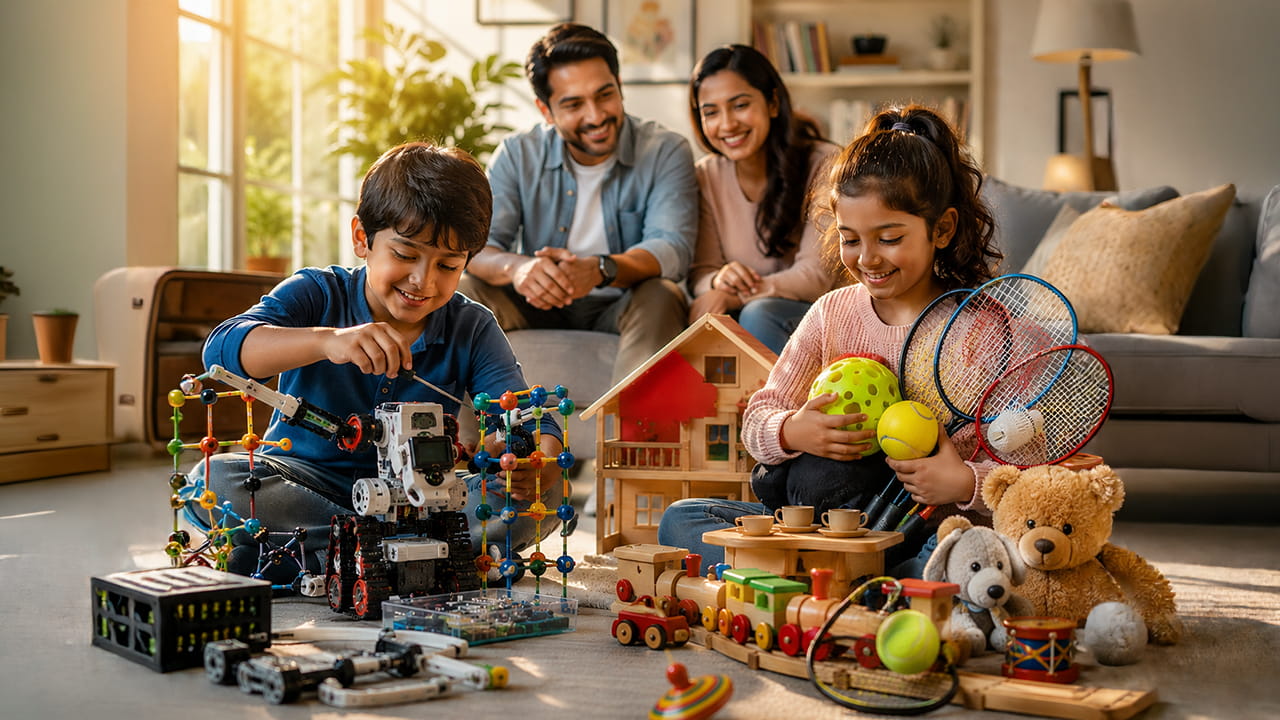
STEM toys are everywhere right now but traditional toys haven’t lost their value, they’ve just lost the marketing budget. Here’s what the research actually says, and how to choose by age.
You’re standing in the toy aisle or scrolling through it at midnight on your phone and there are two carts open in your head. One has a coding robot kit. The other has a simple wooden block set that looks almost exactly like the one your own childhood toy box had. Your child only needs one gift this birthday. So which one actually helps them grow? This is one of the most common questions Indian parents ask in 2026, and honestly, it doesn’t have a one line answer. STEM toys are everywhere right now, and for good reason but traditional toys haven’t lost their value either. They’ve just lost the marketing budget. In this guide, we’ll walk through what the actual research says about STEM toys vs traditional toys, what each one is genuinely good at, and how to pick the right one for your child’s age without falling for hype on either side.
What Are STEM Toys, Exactly?
STEM toys are toys built around Science, Technology, Engineering, and Math concepts like robotics kits, circuit-building sets, coding toys, and logic-based construction sets. They’re designed so a child learns a real concept (gears, electricity, sequencing, cause-and-effect) just by playing. Most STEM toys share three things in common: A hands-on activity with a clear concept behind it Trial-and-error built into the play (something doesn’t work until you fix it) A skill that carries over into school subjects like math and science Think of building sets, simple robotics kits, and logic puzzles toys where the “right answer” exists, but your child has to find it themselves.
What Are Traditional Toys, Exactly?
Traditional toys are the open-ended ones : wooden blocks, dolls, soft toys, puppet sets, play kitchens, and simple pretend-play kits. There’s no instruction manual and no “correct” outcome. A wooden block can be a tower, a phone, or a sandwich, depending entirely on what your child decides that day. This open-endedness is exactly what makes them powerful in a different way they don’t teach a fixed skill, they build the imagination that invents new ones.
What Does Research Actually Say About STEM Toys vs Traditional Toys?
Both are backed by real research, but for different outcomes. STEM toys build measurable cognitive skills. A Toy Association study found that 93% of parents believe STEM toys are beneficial to their kids’ development, and the research backs that instinct up. Children who regularly play with building and construction toys tend to enter school with stronger spatial and mathematical foundations a University of Delaware study found that preschoolers who engaged with building toys scored higher on tests measuring visuospatial processing and executive function, the kind of working memory and attention control that later helps with everything from reading to managing emotions.
Traditional, open-ended toys build something research can’t measure as easily, but values just as much. A decade-long study by the Center for Early Childhood Education compared more than 100 toy types and found that simple, open-ended, non-realistic toys inspired the highest-quality play:leading to more creative play, problem solving, peer interaction, and language development than toys with a single fixed function. In one telling comparison, a plain wooden cash register led to far richer pretend-play conversations than a battery-powered version that just made sounds when buttons were pushed. So neither toy “wins.” STEM toys are better at building specific, school-relevant skills. Traditional toys are better at building the imagination, language, and social skills that don’t show up on a test but show up everywhere else.
Is It Really STEM vs Traditional, or Is the Label the Wrong Question?
“Play is the work of childhood. But not all play is created equal.” The key isn’t the label on the box: ‘STEM’ or otherwise but whether the toy invites active, engaged, meaningful, and socially interactive experiences.”
Dr. Kathy Hirsh-Pasek,
Developmental Psychologist, Temple University
In other words, a STEM-labelled toy your child plays with alone and on autopilot may teach less than a wooden block set your child builds and talks through with a sibling. The label matters far less than how the toy is actually used.

STEM Toys vs Traditional Toys: Skill-by-Skill Comparison
Which One Is Right for Your Child’s Age?
Ages 1–3 (Toddlers): Skip both extremes. Simple stacking toys, soft blocks, and chunky wooden shapes work best: they’re technically “traditional,” but they quietly build the same spatial skills STEM toys claim for older kids.
Ages 3–5 (Preschool): This is where open-ended traditional toys matter most: pretend kitchens, dolls, puppet sets, and basic wooden building blocks. Light STEM exposure (simple cause-and-effect toys) can sit alongside this, not replace it.
Ages 6–8: Introduce real STEM toys, beginner construction sets, simple circuit kits, logic games. Keep traditional toys in rotation too; this is also the age where role-play and board games build social skills fastest.
Ages 9–12: STEM toys can take a bigger share of robotics kits, advanced building sets, coding toys. But don’t fully retire imaginative and social play; strategy board games and creative kits still matter here.

Can You Just Buy Both? (Yes – Here’s How to Balance It)
Most pediatric and education experts land in the same place: don’t choose a side, build a mix. A child who only gets STEM toys may build sharp logic but miss out on empathy, storytelling, and free imagination. A child who only gets traditional toys may have a rich imagination but less exposure to structured problem solving. A simple rule that works for most Indian households: for every STEM or educational toy you buy, add one open-ended traditional toy to the same shelf.
Build a balanced toy shelf in one go
Mega Play’s educational and STEM-style toys are built for hands-on, real-concept learning. Mega Wood’s Montessori-style wooden toys cover the open-ended side: safe, natural materials your child can turn into a hundred different games.

Why This Matters Even More in 2026
Indian parents are actively rethinking the toy aisle right now. Parents, especially millennials and Gen Z, want toys made from wood, fabric, and recycled plastics, with a clear push toward screen-free or screen smart options that encourage active engagement over passive consumption. At the same time, STEM and educational toys are leading category growth because parents want play time to double up as learning time. The honest takeaway: this isn’t really a “STEM vs traditional” fight. It’s a reminder that both categories solve a problem the other one doesn’t and the best toy box in 2026 probably has both.
Frequently Asked Questions
Q. Are STEM toys better than traditional toys for kids?
Not better: different. STEM toys build logic, math readiness, and structured problem-solving. Traditional toys build imagination, language, and emotional and social skills. Most experts recommend a mix of both rather than picking one.
Q. At what age should I introduce STEM toys?
Light STEM exposure (cause-and-effect toys, simple building sets) works from around age 3. More structured STEM toys like circuit kits and robotics sets are better suited from age 6 onward.
Q. Do traditional toys still matter when STEM toys are so popular?
Yes. Research consistently shows open-ended traditional toys produce some of the highest-quality play for creativity, language, and peer interaction skills STEM toys don’t directly target.
Q. Are wooden toys considered traditional or educational?
Both. Montessori-style wooden toys (like Mega Wood’s range) sit in between: open-ended like traditional toys, but their natural materials and simple design also support fine motor and cognitive development.
Q. Is it bad if my child only wants STEM toys?
Not bad, but worth balancing. Mix in open-ended toys occasionally so imaginative and social play doesn’t get crowded out.
Q. How many toys does a child actually need at once?
Fewer, better toys consistently outperform a large pile of toys. A small, balanced mix of one STEM/educational toy and one open-ended toy per age stage works better than buying everything at once.
Q. Can a single toy be both STEM and traditional?
Yes – well-designed wooden building sets and certain construction toys blend both: open-ended like a traditional toy, but with enough structure to build spatial and logical skills like a STEM toy.
Conclusion
If you came here looking for a winner between STEM toys and traditional toys, here’s the real answer: there isn’t one, and you don’t need to pick. Use STEM toys to build logic and curiosity. Use traditional, open-ended toys to build imagination and connection. The smartest toy box in 2026 has room for both.
Ready to balance your child’s toy shelf?
Explore Mega Play’s STEM and educational toy range, and Mega Wood’s Montessori wooden toy collection — built by Shakti Rubber Industries, trusted by Indian families since 1964