

A research-backed, parent-friendly guide to how open-ended toys shape real thinking skills and how to choose the right ones at every age.
Toys & Early Learning Family & Parenting
Walk into any toy aisle and you’ll see two kinds of products: one lights up and entertains for as long as the batteries last, the other, blocks, puzzles, shape sorters, looks almost boring by comparison. Yet it’s the second kind that child development experts keep coming back to.
The real value of a toy isn’t how flashy it is. It’s whether it gets a child to think, experiment, fail, try again, and eventually figure something out on their own. A Toy Association report found that 73% of parents believe educational toys help improve their children’s problem-solving skills, and the reason isn’t marketing — it’s how these toys are designed from the ground up. In this article, we’ll look at exactly how educational toys build creativity and problem-solving skills, what the research says, and how to pick the right ones for your child’s age and stage.
What Makes a Toy “Educational” in the First Place?
Not every toy labelled “educational” actually is one. The real markers are simpler than the packaging suggests:
Purposeful design : it teaches a specific skill, like shapes, balance, or cause-and-effect, rather than just reacting to a button press
Open-ended play : it can be used in more than one way, so the child decides what happens next
Age-appropriate challenge: not so easy that it’s boring, not so hard that it’s frustrating
Process over outcome: the value is in the figuring-out, not just the finished result
A wooden block set, a jigsaw puzzle, or a simple building kit usually scores well on all four. A toy that only lights up and plays a pre-recorded sound usually scores on none.
How Do Educational Toys Build Creativity?
Creativity isn’t a talent some kids have and others don’t: it’s a skill that gets built through repeated, low-pressure practice. Open-ended toys are exactly the kind of practice creativity needs.
They have no single “right” answer: A box of building blocks can become a tower, a bridge, or a spaceship depending on the day. That open-endedness forces a child to generate their own ideas instead of following someone else’s script.
They reward imagination, not memorisation: Unlike toys with a fixed outcome, creative toys let a child’s imagination genuinely change what the toy becomes.
They encourage storytelling: Pretend-play toys, kitchen sets, dollhouses, action figures, push children to build entire narratives, one of the earliest and most powerful forms of creative thinking.
They survive boredom better : A child can return to the same set of blocks fifty times and build something different each time a sign the toy is genuinely exercising creative thinking, not just entertaining.
How Do Educational Toys Build Problem-Solving Skills?
Problem-solving is essentially a loop: try something, see what happens, adjust, try again. Good educational toys are built to put a child through that loop dozens of times in a single play session.
Puzzles teach spatial reasoning and persistence there’s no shortcut, only trial, error, and adjustment
Building and construction sets teach planning, balance, and structural cause-and-effect, often described by educators as the strongest predictor of later STEM interest
Shape sorters and matching games: teach early logical categorisation in toddlers
Strategy-based board games: teach sequencing, prediction, and weighing trade-offs
What ties all of these together is hands-on learning. Research indicates that hands-on activities lead to roughly 60% retention of concepts compared to traditional, passive methods, a child who builds a wobbly tower and watches it fall genuinely understands balance better than one who’s only told about it.
Why Does “Productive Struggle” Matter So Much?
Here’s something that surprises a lot of parents: the moment a puzzle piece doesn’t fit, or a tower collapses, is actually the most valuable part of the toy. Educators call this productive struggle
the small, safe frustration of not immediately succeeding. When a child pushes through that moment on their own, three things happen at once: they build resilience, they learn that effort leads to improvement, and they get a small, earned confidence boost when it finally works. Toys that solve everything for the child, by lighting up the “correct” answer, for instance, quietly remove this entire learning loop. This is why simpler, more open-ended toys often outperform flashier ones. The struggle is the lesson.
How Much Does Screen-Free Play Matter Here?
A lot, as it turns out. Most of the educational value described above (creativity, persistence, spatial reasoning) comes specifically from physical, hands-on, screen-free play. A tablet game can teach pattern recognition, but it can’t replicate the feel of stacking real blocks, the frustration of a real puzzle piece not fitting, or the pride of a tower that actually stands. This doesn’t mean screens have no place. It means that for the specific skills of creativity and problem-solving, physical educational toys still do something digital play simply can’t fully replace. The chart below shows how parents tend to rate different toy types on their real educational value, based on aggregated industry survey findings on parent perceptions of skill-building toys.

Which Educational Toys Are Best for Each Age Group?
Ages 1–3: Shape sorters, stacking rings, simple cause-and-effect toys, and soft building blocks. The goal here is basic categorisation and motor coordination, not complexity.
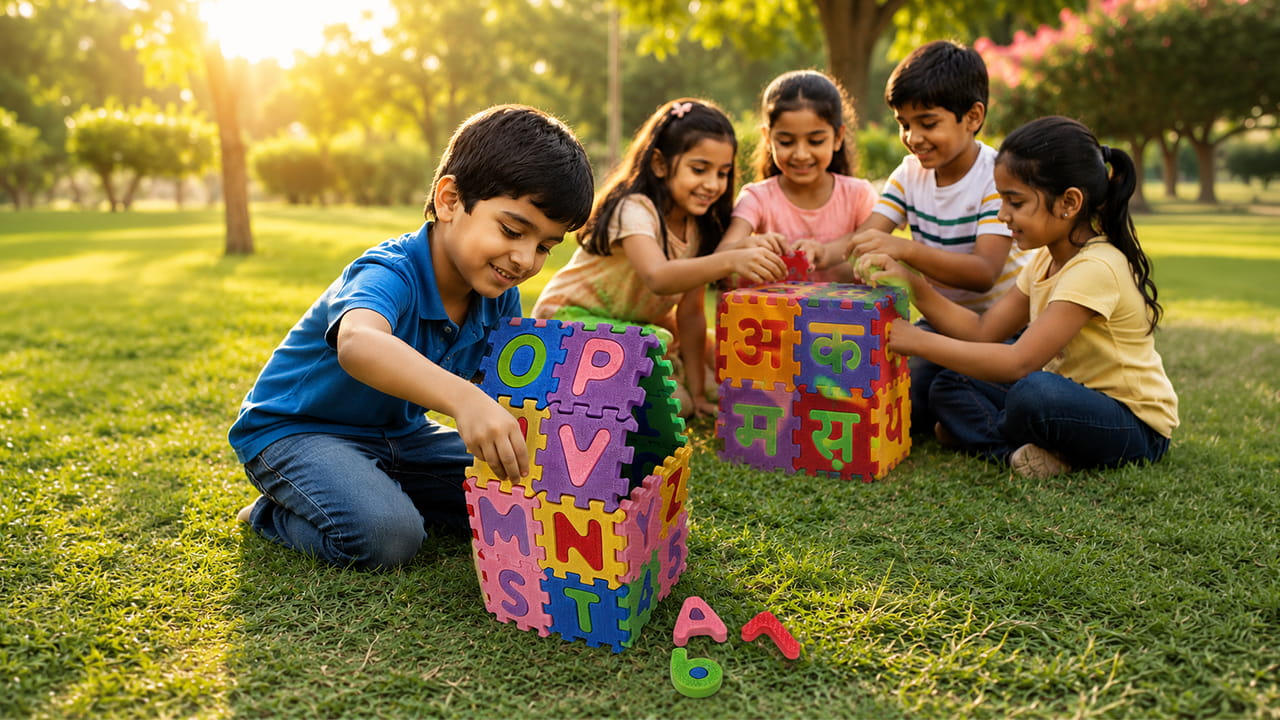
Ages 3–5: Wooden blocks, simple puzzles (12–24 pieces), pretend-play sets like kitchen toys or dollhouses, and beginner construction sets. This is when imaginative, open-ended play really takes off.
Ages 6–9: More advanced construction and building sets, strategy-based board games, larger puzzles, and early STEM kits. Children at this age can handle multi-step problems and benefit from toys that reward planning.
Ages 10 and above: Complex building systems, logic and strategy games, and creative kits that combine art with engineering. Older children benefit from toys that let them design their own outcomes rather than follow instructions. A simple rule of thumb: if your child solves a toy too quickly or starts ignoring it, that’s usually a sign they’ve outgrown its level of challenge — not that the toy has failed.
How Can Parents Choose the Right Educational Toy?
1. Favour open-ended over single-purpose: A toy that can be used many different ways will hold a child’s interest and teach more far longer than one with a single fixed function.
2. Match the challenge to the child, not the box: Age labels are a starting point, not a rule; watch how your child actually engages with a toy.
3. Choose fewer, better toys: Research consistently shows children play longer and more creatively when they have fewer toys to choose from, not more.
4. Prioritise durability: A building set or puzzle that survives daily, repeated play teaches far more than one that breaks after a week.
5. Let the struggle happen: Resist stepping in the moment a puzzle gets tricky; that small struggle is where most of the learning actually occurs.
Looking for Toys That Actually Build Thinking Skills?
Explore our Mega Play, Hello Friends, and Mega Wood toy collections: open-ended, durable, and designed for the kind of play that grows with your child.
Frequently Asked Questions
1. How do educational toys help build creativity in children?
Educational toys that are open-ended :like building blocks or pretend-play sets: have no single correct outcome, which pushes children to generate their own ideas and imaginative solutions every time they play.
2. What types of toys are best for problem-solving skills?
Puzzles, construction and building sets, shape sorters, and strategy-based board games are among the most effective, since each requires trial, error, and adjustment to succeed.
3. At what age should children start playing with educational toys?
Children can benefit from educational toys as early as 12 months, starting with simple shape sorters and stacking toys, and progressing to more complex puzzles and building sets as they grow.
4. Are screen-based educational apps as effective as physical toys?
Physical, hands-on toys generally build spatial reasoning, persistence, and creativity more effectively than screen-based alternatives, since they involve real trial-and-error and tactile feedback that apps can’t replicate.
5. How do I know if a toy is too easy or too hard for my child?
If a child loses interest quickly or solves something instantly, it may be too easy; if they get frustrated and give up repeatedly without any success, it may be too advanced. The right toy sits just slightly beyond their current comfort zone.
6. Why is it important to let children struggle with a toy instead of helping right away?
That small struggle, often called productive struggle, is where most learning happens, it builds resilience, persistence, and a genuine sense of accomplishment once the child solves it themselves.
7. Do fewer toys actually help children learn better?
Yes. Studies show that children tend to play longer, more imaginatively, and more deeply when they have fewer toy options available, rather than being overwhelmed by too many choices